
Unlocking AI’s true value: strategy beyond productivity.
Companies are pouring money into AI. But for many, the promised return on investment never shows up. The usual story: lots of activity, little financial impact.
Unlocking AI’s True Value: Strategy Beyond Productivity
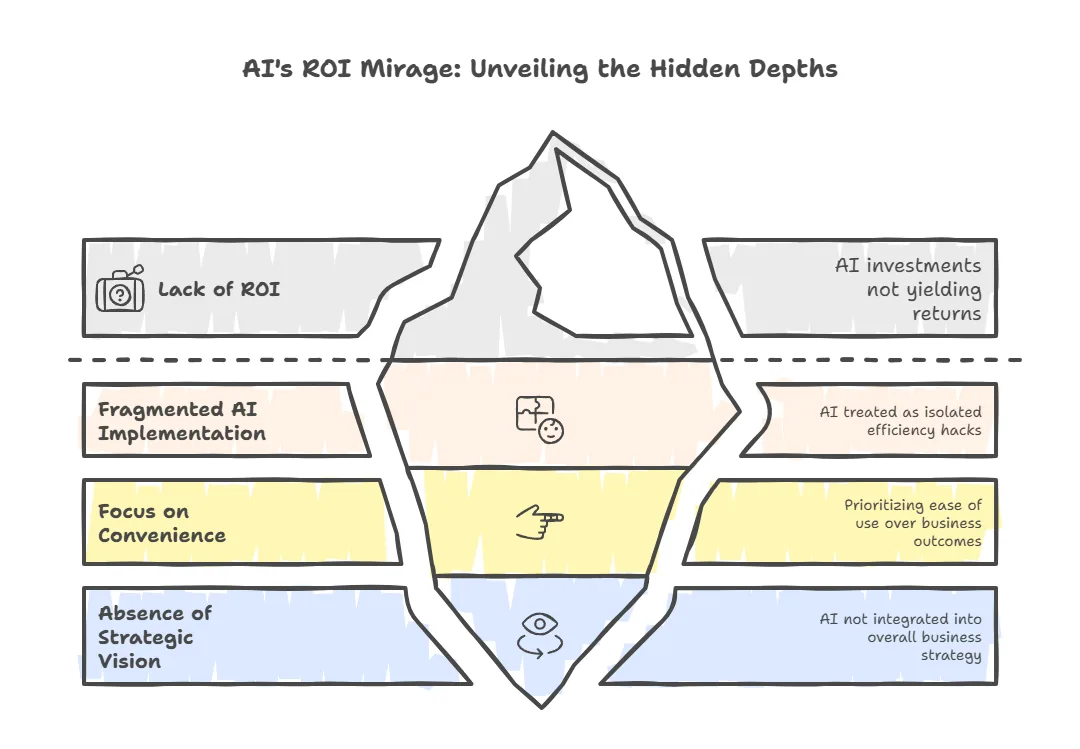
The ROI Mirage: Why AI Isn’t Paying Off (Yet)
Companies are pouring money into AI. But for many, the promised return on investment never shows up. The usual story: lots of activity, little financial impact.
Why? Most teams treated AI like a set of small efficiency hacks instead of a business-changing strategy. They chased convenience over outcomes.
These lessons come from real-life work leading AI programs and partnering with innovative AI companies — not theory, but what actually holds up under pressure.
This is how to fix it.
The Productivity Trap: Time Saved ≠ Money Earned
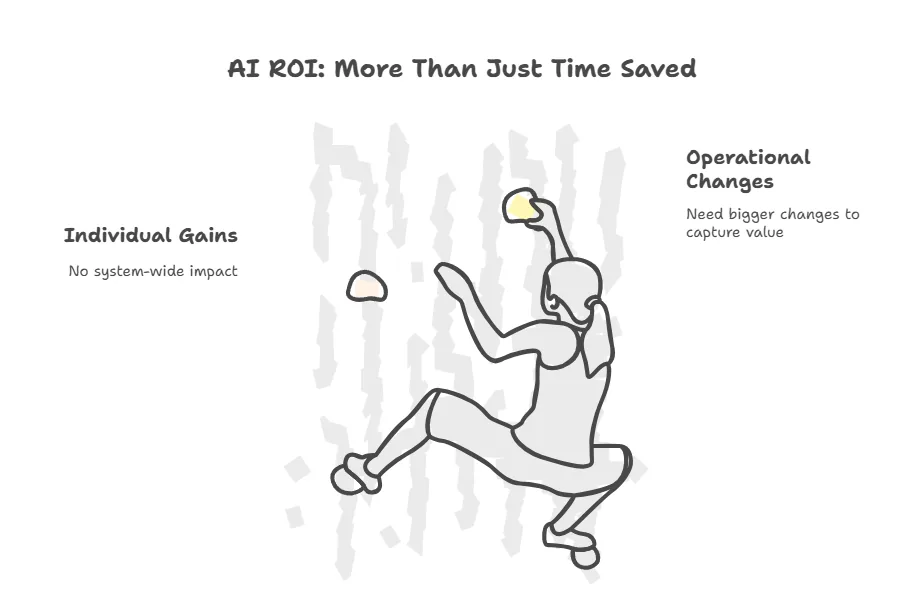
Most AI efforts start with “everyday AI” — tools that help employees work faster. Think assistants, text generators, or small automations. These can make tasks quicker. CIOs/CFOs see time saved. But time saved is not the same as money saved.
Two reasons this rarely turns into real ROI:
-
Individual gains don’t add up to system-wide impact
-
You need bigger operational changes to capture value
What works in practice:
-
Workforce adoption: Real training, change management, and front-line confidence
-
Workflow redesign: Updated processes, redefined roles, sometimes new team structures
Without that, productivity tools take the long road to ROI. In reality, the AI winning organizations invest as much in business change as in the technology itself.
Shift the Focus: Aim AI at Revenue and Product, Not Just Tasks
If you want meaningful value, prioritize use cases that clearly move the bottom line or reshape your product.
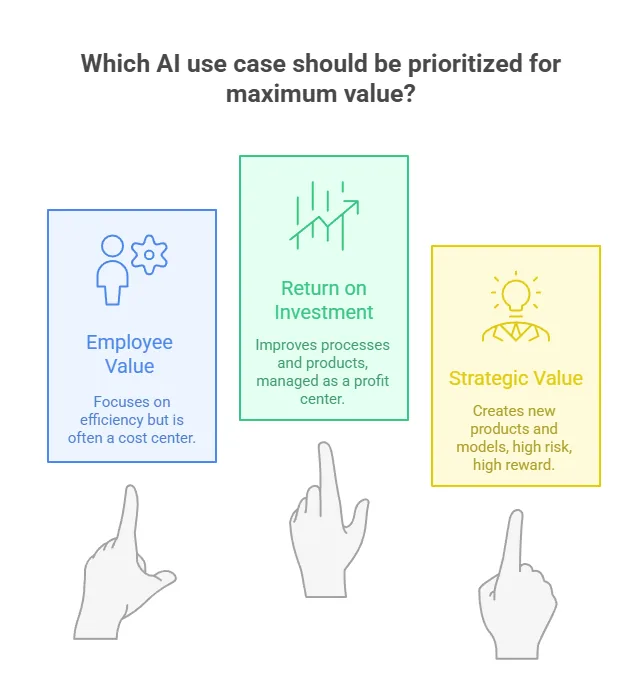
Set an AI ambition that guides your choices:
-
Employee Value: Make people more efficient. Useful, but usually a cost center.
-
Return on Investment: Improve core processes and embed intelligence into products. Managed like a profit center.
-
Strategic Value: Create new products, services, or business models. High risk, high potential reward.
Real-world takeaway: Focus your bets on ROI and Strategic Value. That’s where AI connects directly to revenue, product differentiation, and measurable financial outcomes. Instead of vague “productivity,” target concrete “financial efficiency” — better contract terms, pricing, smarter capital usage.
Make It a Leadership Priority
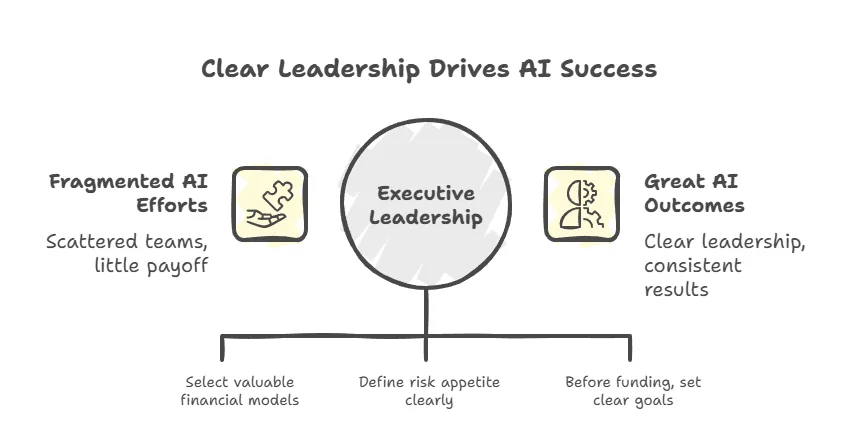
Great AI outcomes don’t come from cool tools alone. They come from clear leadership.
What works with executive teams:
-
Pick the right use cases and financial models (Yes, many AI use cases require a different financial model)
-
Set strategy and risk appetite up front
-
Define the problem, expected value, and success metrics before funding
When AI is left to scattered teams or a single function alone, you get fragmented efforts and “AI strategy debt” — lots of projects, little payoff. You will want to avoid that mistake at all costs
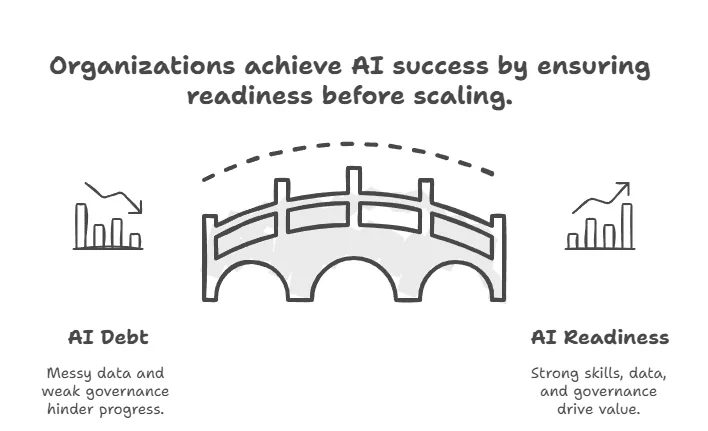
Readiness First: Don’t Scale What Isn’t Ready
Before scaling, check if your organization is truly ready. Success needs both:
-
Human readiness: Skills, adoption, change capacity
-
AI readiness: Data quality, governance, platform maturity
If those are out of sync, value leaks. Common blockers we encounter: messy data, weak governance, missing skills — forms of “AI debt” that compound over time.
Avoid spreading thin across dozens of pilots. In practice, the winners concentrate on what matters most:
-
Define your portfolio mix across Strategic Value, Return on investment, and Employee value — aligned to your core strategy
-
Prioritize initiatives with the highest financial impact and feasibility, especially on the “Return on investment” part
-
Use a rigorous, repeatable process for selecting, vetting, prioritizing, and funding use cases. If it doesn’t make business sense, don’t spend the money
Bottom Line
Stop expecting small productivity boosts to deliver big ROI. Put leadership in the driver’s seat. Aim AI at revenue, product, and process advantage. Build organizational readiness. These lessons come from hands-on execution, and we’ve had a few successes! When you apply them, AI shifts from a cost center to a real engine of competitive advantage.