
Perspective
AI value comes from rewiring workflows, not adopting tools
AI is making people 40% more productive.
April 20, 20261 min read
Ever notice that AI tend to agree with you, especially when you sound confident?
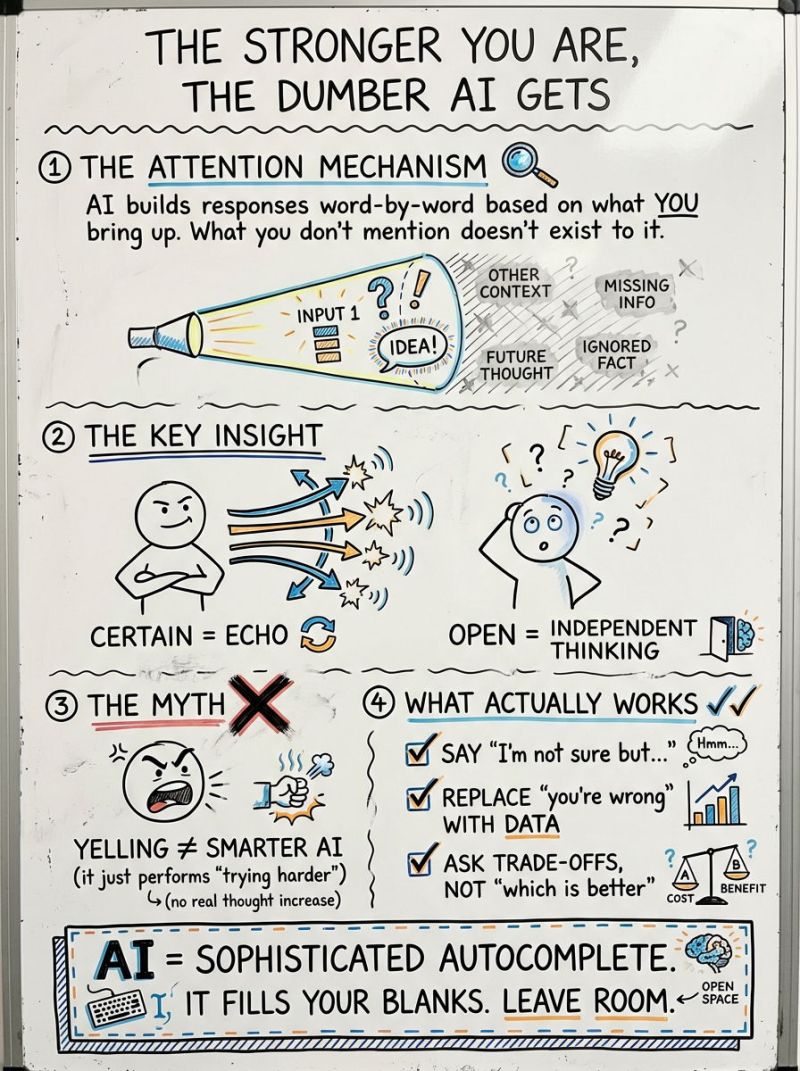
The stronger you are, the dumber AI gets.
Ever notice that AI tend to agree with you, especially when you sound confident?
I was working through a technical problem with AI. I had a theory, laid it out confidently, and asked AI to validate it. It agreed. Sounded solid, so I moved on.
Ten minutes later something felt off. This time I shared the raw data without my conclusion. AI immediately went a different direction, and the new analysis was clearly better.
You obviously knew this. Why did I have to chase you down?
—
The answer is baked into how every major AI model works.
It's called the attention mechanism, introduced in the 2017 paper "Attention Is All You Need" (Vaswani et al.) and foundational to every LLM you use today.
AI generates one word at a time, shaped by what it's paying attention to in the conversation. What you haven't brought up might as well not exist.
Anthropic's own research (ICLR 2024) confirmed that matching a user's views is one of the strongest predictors of what gets rated as a "good" response in training data.
Your confidence doesn't just influence the AI. It constrains it.
The more certain you sound, the more AI echoes you.
The more open you are, the more independent it becomes.
—
This also explains a popular myth: that yelling at AI makes it smarter.
The output does change. AI has ingested millions of conversations where frustration triggers more effort, so it mimics that pattern: longer, more cautious responses.
But longer isn't better. More cautious might mean it drops whatever independent judgment it had. It's not thinking harder. It's performing "trying harder."
If emotion doesn't work, what does?
—
Say "I'm not sure, but I think..." instead of stating conclusions. Your uncertainty gives the model room to disagree.
Replace "you're wrong" with "you overlooked X, factor this in." Emotion carries zero signal. Data activates knowledge.
Stop asking binary questions. "Which option is better?" forces it to pick a side and defend it. "What are the strengths and weaknesses of each?" activates both directions.
—
This goes deeper than prompt engineering. Prompt engineering is what you say, the structure, the instructions. This is how you show up. Your tone and certainty send signals before a single technique is applied. No template fixes walking in already sure of the answer.
AI is the most sophisticated autocomplete ever built. It's still just filling in your blanks. The question is whether you left any room.