
The real logic behind how AI changes work.
The “AI and jobs” conversation has produced endless anxiety, plenty of uncertainty, and almost no clarity. Especially on the question that matters most: how do you know if your role is exposed?
The Real Logic Behind How AI Changes Work
The “AI and jobs” conversation has produced endless anxiety, plenty of uncertainty, and almost no clarity. Especially on the question that matters most: how do you know if your role is exposed?
This article gives you a framework - a lens to look at your own role, your own team, and your own organization, and understand with more precision how AI changes the work you do.
What you'll walk away with:
-
A mental model that breaks all knowledge work into four types, so you can map exactly where AI hits hardest
-
A two-phase roadmap showing the sequence of disruption, from individual productivity to cross-system automation
-
The math on how the mix of work shifts when both phases compound
-
A quick litmus test for which roles and tools are most exposed, and which become more valuable
-
Two underrated risks that most don't see until it's too late
Why Every Org Became a Pyramid
If organizations are just structures for getting work done, what does that structure tell us about where AI creates leverage - and where it creates disruption?
Traditional structure scales through adding more people. As company grows, more layers (middle management) are added, therefore the pyramid shape. Naval Ravikant calls this "labor leverage" - using people to amplify your output.
This isn't a design choice. It's a constraint.
And it matters because every layer in that pyramid exists to handle a specific kind of work - work that AI is now learning to do.
Which brings us to the real question: what kinds of work are there?
Four Types of Work
You have hundreds of job titles in your org. But what are people actually doing all day? And which of those activities can AI absorb first?
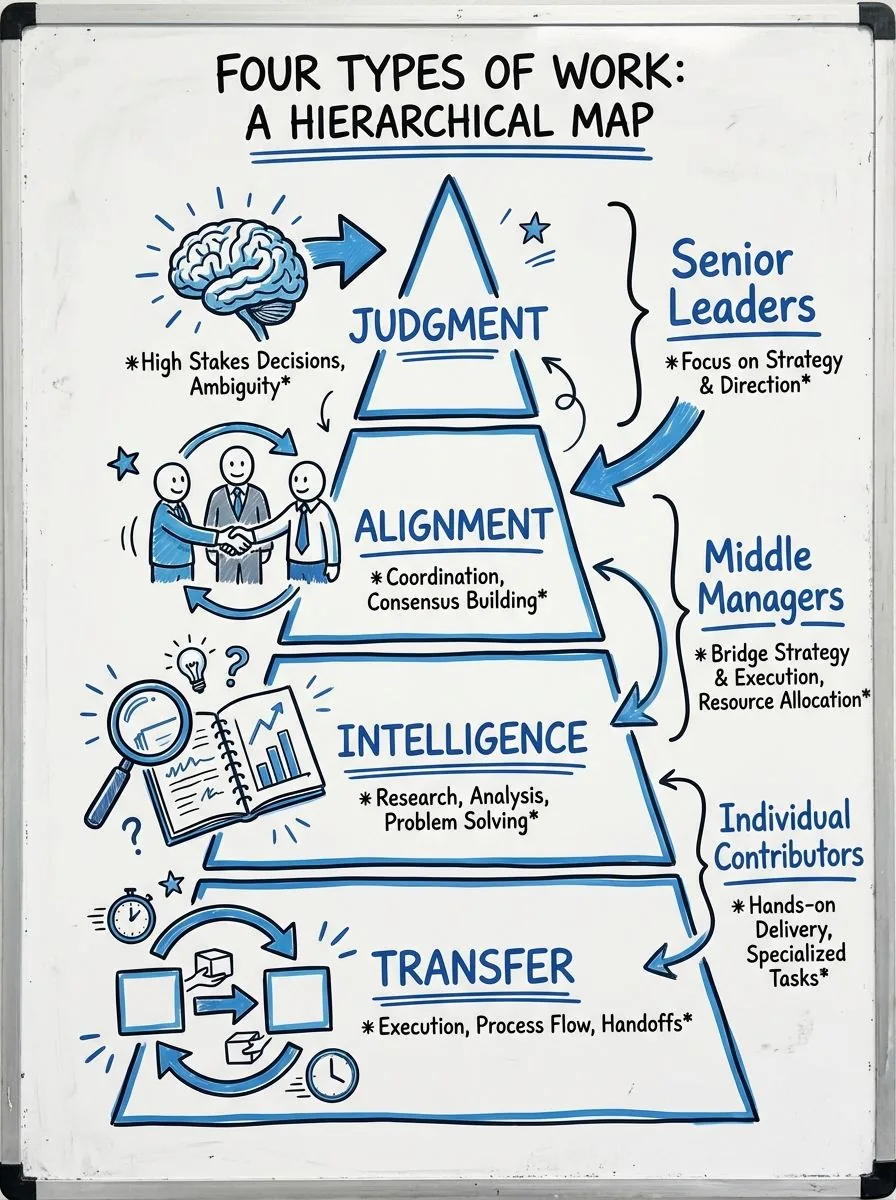
This is the core framework. It gives you a vocabulary to audit any role, and predict how AI will reshape it. Everything else in this article builds on it.
Every role looks different on the surface. But strip it down and there are really only four types of work:
-
Judgment Making decisions. Which direction do we go? How much do we invest? The higher you are, the more of your day is this. A CEO's job is almost entirely judgment.
-
Alignment Managing relationships, resolving conflicts, building consensus across teams and stakeholders. The larger the organization, the more alignment work there is. This is where middle managers spend most of their time.
-
Intelligence Gathering and synthesizing information to support decisions. Market research, competitive analysis, data reports, contract reviews. The closer you are to the front lines, the more of this you do.
-
Transfer Moving information between systems. Copying requirements from a Slack thread into Jira. Translating a design spec into a PRD. Pasting PRD logic into an AI chat window. The more tools an organization uses, the more transfer work there is. It's the least creative work, and the biggest time sink.
Why this matters
These four types aren't evenly distributed across an org chart:
-
Senior leaders → mostly judgment and alignment
-
Middle managers → mostly alignment and intelligence
-
Individual contributors → mostly intelligence and transfer
Once you see that distribution, the order of AI's impact becomes predictable - it starts at the bottom of the stack and works upward.
- Key takeaway: Map your own calendar from last week against these four categories. See if you are surprised by how much time goes to transfer and intelligence, the two categories AI compresses first. That's your personal exposure map.
Phase 1 - Individual Productivity
What actually happens inside an organization when individuals start using AI - and what does it mean for the people who adopt early versus the people who don't?
This is the phase most companies are living through right now. Understanding its mechanics helps you see whether the "time dividend" you're getting is sustainable, or a shrinking window.
The quiet beginning
The first wave is quiet. Curious early adopters plug ChatGPT or Claude into their workflows:
-
Code ships faster
-
PRDs get written in a fraction of the time
-
Competitive analysis that took a week now takes an hour
What's really happening: AI is compressing intelligence and transfer work dramatically.
The new work few expected
But something important happens at the same time - a new type of work emerges.
Reviewing AI output.
Is this code correct? Did the research miss anything? Does this recommendation actually fit our business context?
That's judgment work. The old pain point disappears, but a review step takes its place. The center of gravity shifts upward.
The time dividend - and its expiration date
Early adopters get a "time dividend", finishing eight hours of work in three.
But the window is short. Once AI goes from power-user toy to company-wide tool, leadership notices the gap between output and headcount. And they start cashing in.
The early adopter advantage isn't a head start. It's a countdown.
That's where the path forks:
-
Ideal path: Freed-up capacity fuels growth. Headcount stays, but roles level up - people move from execution to higher-judgment work.
-
Common reality: The market isn't growing at the same pace. Efficiency gains translate directly into redundancy.
Which roles are most exposed?
One pattern holds: the easier it is to quantify someone's output, the more vulnerable that role becomes.
Not because the work doesn't matter, but because "quantifiable" gives AI a clear benchmark to match.
Take product and engineering as an example. Pixel-perfect UI execution done strictly to spec? A product manager with a coding agent can increasingly handle that.
But notice what's happening, the role of "frontend engineer" isn't disappearing. The bar for what it means is rising. Writing React components used to be the job. Now the job is designing end-to-end interactions, understanding performance tradeoffs, and thinking about accessibility.
AI absorbed the execution layer. What's left is the judgment layer. This pattern repeats everywhere.
AI didn't come for the jobs that are hard to describe. It came for the jobs that are easy to measure.
How organizations change shape
By the end of Phase One, organizations look structurally different:
-
Fewer people, but each person's capability bandwidth is wider
-
Middle management thins out - the traditional "information relay" role weakens as AI helps executives understand frontline data directly, and helps ICs grasp strategic direction without a human intermediary
-
Key takeaway: If your value is primarily in intelligence or transfer work: research, reporting, moving information between tools. That value is compressing fast. The durable advantage is shifting toward judgment: the ability to evaluate, decide, and course-correct using context that AI doesn't have. Ask yourself: how much of my day is spent making decisions that actually require human judgment?
Phase 02 - Collaboration Efficiency
Individual productivity is only half the story. What happens when AI stops helping one person at a time and starts connecting entire workflows end to end?
This phase hasn't fully arrived yet - but it's coming fast. Understanding it now helps you evaluate your tech stack, your team structure, and your vendor choices with a three-year lens instead of a three-month one.
What's making this possible now? Agent architectures. AI systems that don't just respond to prompts but can read from, reason across, and write back to multiple tools autonomously. The building blocks - function calling, tool use, persistent memory are maturing fast. The infrastructure is landing now.
The black hole Phase One didn't touch
Phase One solved "individuals working faster." But it left a massive efficiency black hole untouched - the transfer of information between systems.
Picture a typical product workflow:
-
A stakeholder drops a request in a group chat
-
A PM copies it into Jira and creates a ticket
-
A designer opens Figma to build a prototype
-
Someone writes the PRD in a separate doc
-
An engineer opens four different systems to read the requirements, review the design, understand the logic, and finally write the code
Every single handoff is a transfer step and every transfer step is a place where context gets lost, details get mangled, and time gets wasted.
Here's the irony of the AI era: you still have to copy-paste the PRD into a Claude chat window to get AI help with it.
What changes when agents connect the dots
When AI agents can connect directly to these systems - reading from Jira, pulling context from Figma, writing back to the codebase, all of that transfer work disappears.
A key prediction:
Any software that can't be accessed by an AI agent will gradually get pulled out of the workflow.
This is the same dynamic as mobile in 2015 - if your product didn't work on a phone, it was on borrowed time. Agent-accessibility is the new mobile-responsiveness.
This is bigger than product and engineering
Finance approvals. HR performance reviews. Legal contract analysis.
Every workflow in every department is loaded with transfer work, waiting to be connected.
- Key takeaway: Audit your tool stack with one question: can an AI agent read from and write to this system? If the answer is no, that tool is on borrowed time. The same applies to your processes - any workflow that requires a human to manually shuttle information between systems is a workflow waiting to be automated or eliminated.
The Compounding Effect
When both phases stack on top of each other, how dramatically does the composition of work actually shift?
This is the punchline. These numbers give you a planning framework for headcount, hiring profiles, and skill development priorities. These ratios will vary by industry, role, and how far along your organization is in both phases, but the direction is consistent.
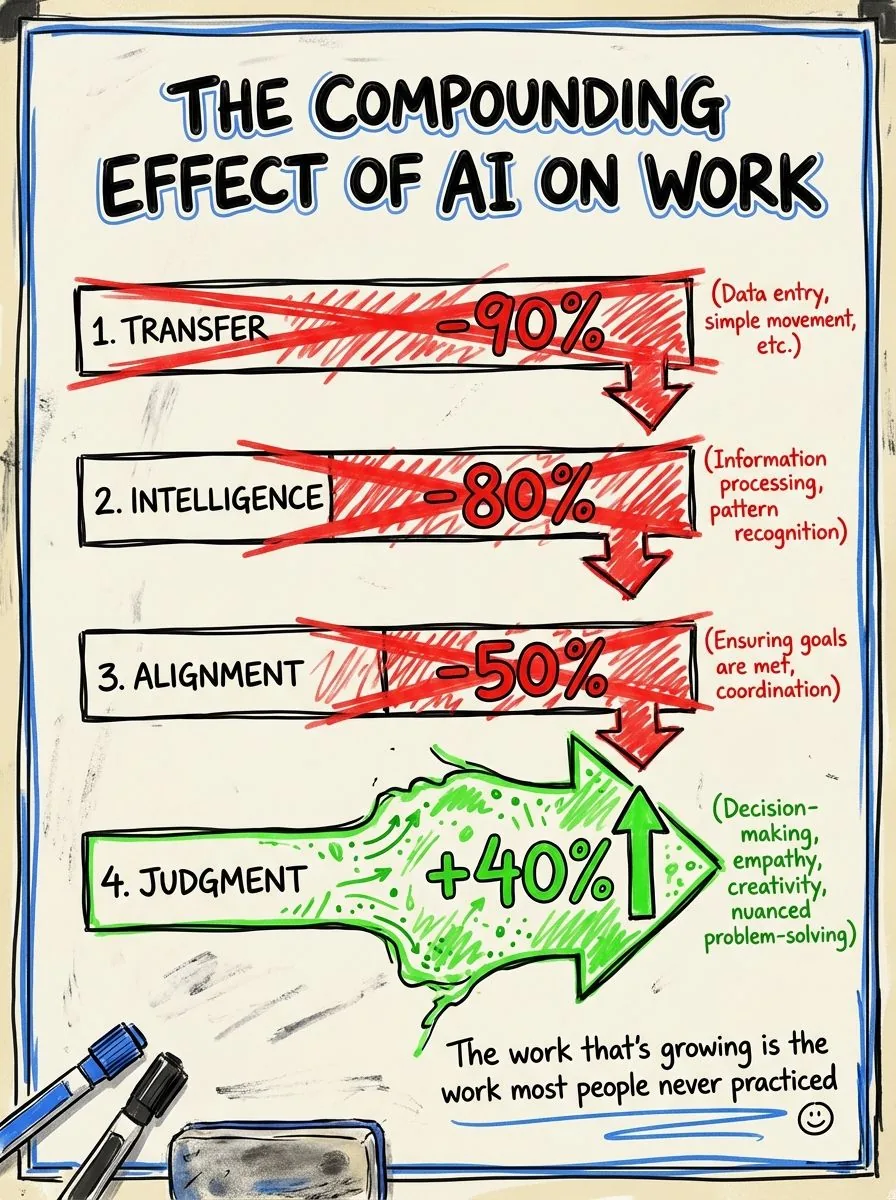
The math
Phase One compresses the work individuals do. Phase Two eliminates the friction between them. When both hit simultaneously, the shift is dramatic:
-
Transfer work: −90%
-
Intelligence work: −80%
-
Alignment work: −50%
-
Judgment work: +40%
Why the +40% is the hardest number in the list
Look at those numbers carefully.
The three types of work that shrink are the ones that have traditionally filled most of a knowledge worker's day. The one that grows - judgment, is the one that most people have the least practice doing, because they've spent their careers buried in the other three.
The people who remain aren't idle. Their work has shifted upward. Everyone is making more decisions, with more autonomy, across a wider scope.
And that happens to be the thing AI is still worst at - because good judgment requires lived context, organizational memory, and the ability to weigh tradeoffs that don't fit neatly into a prompt.
- Key takeaway: If you're a leader, future hiring should index heavily on judgment capability, not speed of execution. If you're an individual contributor, investing in domain expertise, business context, and decision-making quality is a higher-ROI career move than learning yet another tool.
Two Risks Worth Watching
Efficiency gains are obvious. But what's being quietly lost in the process — and why should leadership care before it's too late?
These risks won't show up in your quarterly metrics. They're slow-burn problems that compound silently — and by the time they surface, the damage is done.
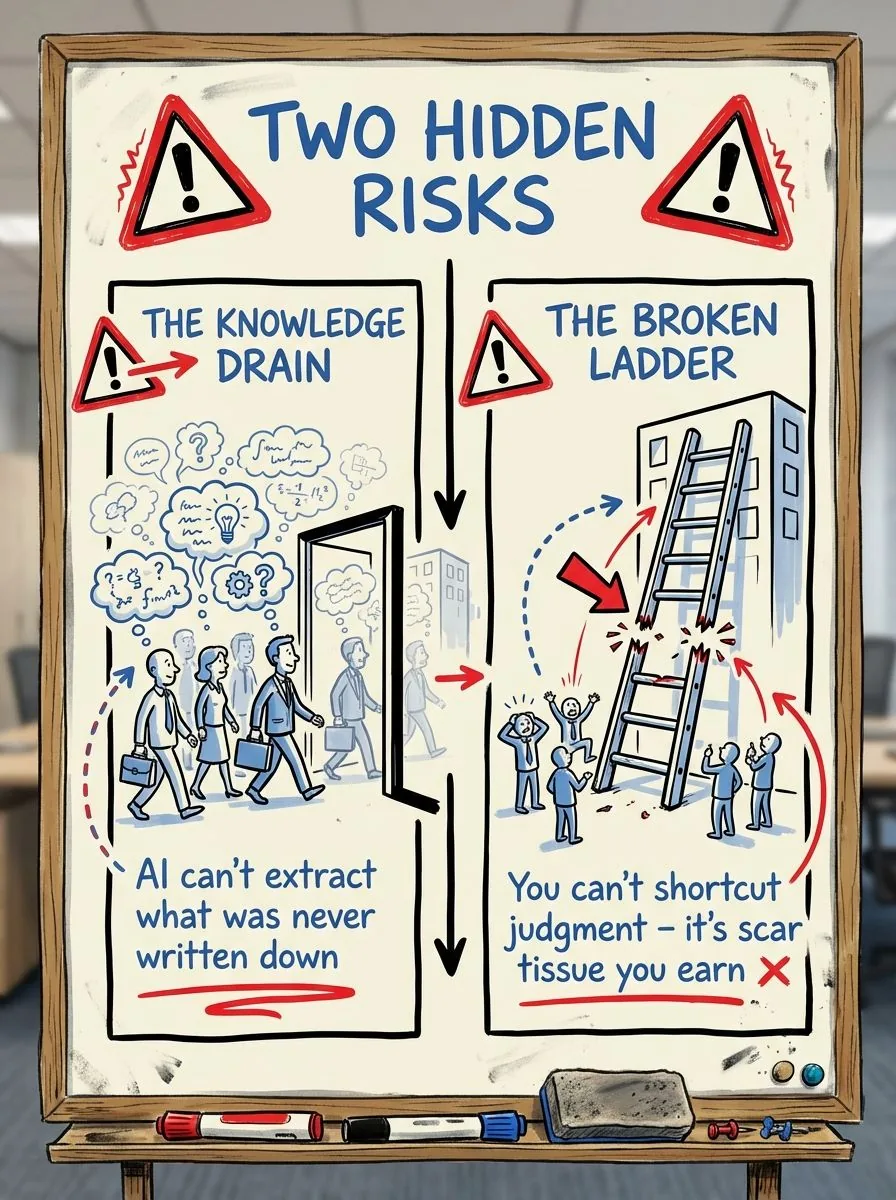
⚠️ Risk 1: The Knowledge Drain
When middle management gets compressed, a huge amount of tacit knowledge disappears with it.
-
Why does this client need special handling?
-
Why did that approach fail last time?
-
Which vendor can't be trusted?
This knowledge lives in people's heads, not in any document or database. AI can't extract what was never written down.
Organizations chasing efficiency may be quietly dismantling their own institutional immune system - the accumulated judgment that protects them from repeating expensive mistakes.
⚠️ Risk 2: The Broken Ladder
Junior roles shrinking dramatically means the career pipeline breaks.
Five years from now, every senior person in the organization was trained in the pre-AI era. New hires never walked the full growth path.
This matters because AI can replace execution, but there's no shortcut for developing judgment. Judgment comes from trial and error in real business situations, from making small decisions, getting some wrong, and building intuition over time.
Judgment is not a skill you learn - it's scar tissue you earn.
Eliminate the entry-level roles where that learning happens, and you've cut off the supply of future senior talent. You've optimized the present at the cost of the future.
- Key takeaway: Before you cut headcount, ask two questions. First: what knowledge lives only in the heads of the people you're about to let go, and how do you capture it before it walks out the door? Second: how will the next generation of leaders develop judgment if there are no junior roles left to grow through? The organizations that solve these two problems will have a massive talent advantage five years from now.
The Bottom Line
The nature of work hasn't changed.
Judgment, alignment, intelligence, transfer - those are the four things. What's changing is which ones humans are responsible for.
The first wave compresses intelligence work. The second wave breaks the bottleneck between systems. Stack them together, and work's center of gravity shifts decisively toward judgment.
The organizations that win will be the ones that figure out how to preserve institutional knowledge and keep the judgment pipeline. The people who thrive won't be the ones who work fastest. They'll be the ones who judge best.
Efficiency is table stakes. The real edge is knowing what not to optimize away.