
Playbook
What is harness engineering, and why does it matter?
'Harness Engineering' - another AI buzzword. What is it, what does it do, does it matter?
April 11, 20262 min read
Most companies are applying AI to individual tasks while leaving the structure of work untouched. That's why it feels like everyone's moving faster but nothing's actually getting easier.
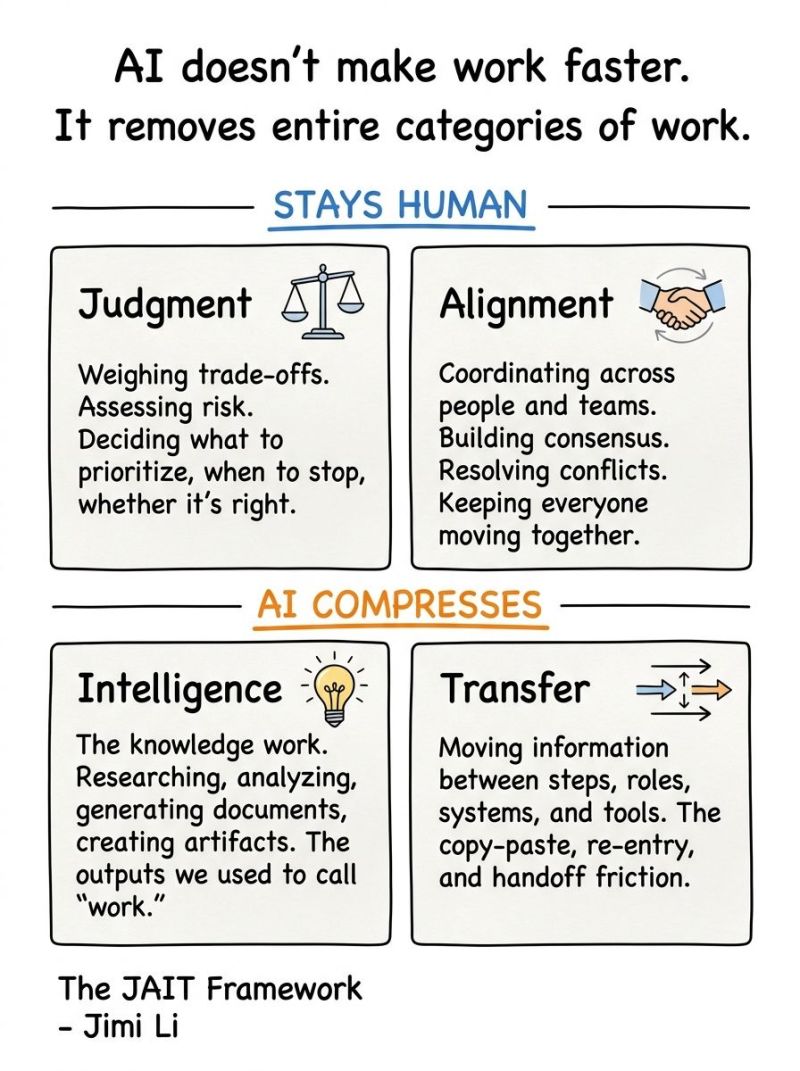
AI is making people more productive.
But most teams feel more chaotic, not less.
The productivity gains are real. The workflow gains aren't.
Most companies are applying AI to individual tasks while leaving the structure of work untouched. That's why it feels like everyone's moving faster but nothing's actually getting easier.
The real shift isn't speed. It's reorganization.
I use a framework called JAIT to break down work and redesign it for the AI era:
Judgment – decisions (stays human)
Alignment – coordination (stays human)
Intelligence – the knowledge work (AI compresses)
Transfer – moving information between steps (AI compresses hardest)
AI removes entire categories of work. That forces the workflow itself to reorganize.
Here's how it plays out in product development:
Before:
PM writes PRD → Eng interprets → Code → QA writes tests → Testing → Release
Each handoff = Transfer. Each role re-learns the problem = Intelligence repeated.
After:
PM ↔ Eng ↔ QA working on shared artifacts, AI handling the translation layer.
Intelligence is centralized. Transfer is automated. The loop tightens.
The roles don't disappear. They elevate:
PM shifts from document writer → intent designer
Engineer shifts from builder → orchestrator
QA shifts from executor → risk strategist
Tasks redistribute, but ownership deepens.
The old model: sequential handoffs, siloed roles, repeated context.
The new model: continuous loops, shared system, AI-mediated collaboration.
This isn't about making each step faster.
It's about removing the steps that existed only because humans couldn't share context efficiently.
If you're struggling to figure out where AI fits in your workflows, use JAIT:
Map your current process
Label each step: Judgment, Alignment, Intelligence, or Transfer
The Intelligence and Transfer steps? Those are your compression targets
Redesign around what remains: Judgment and Alignment
Stop asking "where can we apply AI?"
Instead: "Which parts of our workflow exist only because of human limitations?"
Those are the parts that collapse. What remains is where your people should be spending their time.